

Customers use it because it is fast, familiar, and convenient. Support teams use it because it allows them to communicate directly with customers without requiring additional apps or complicated support portals.
But as support volumes grow, many businesses face the same challenge: their teams spend a significant amount of time answering the same questions repeatedly.
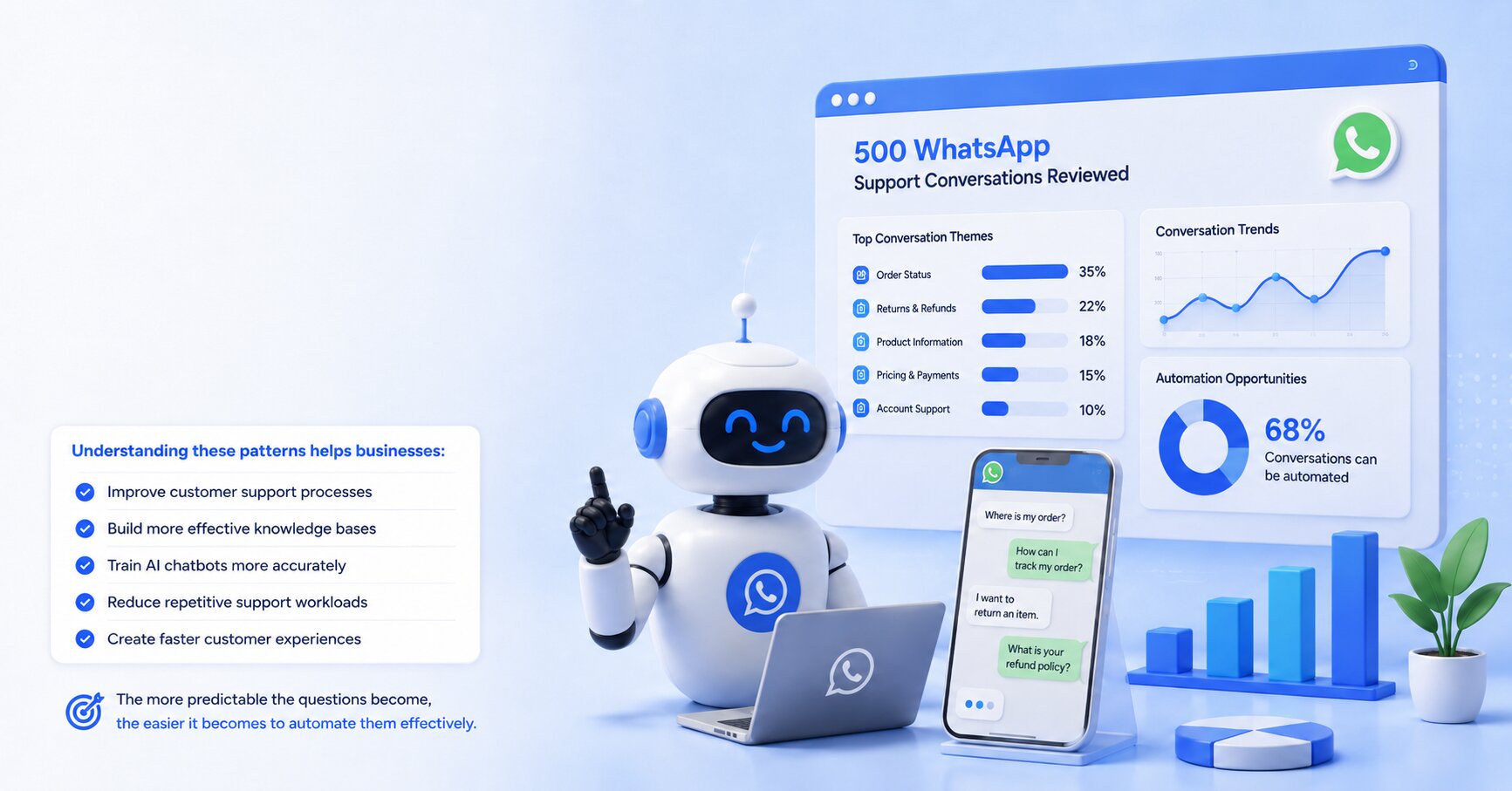
To better understand these patterns, we reviewed 500 WhatsApp customer support conversations and looked for common themes, recurring questions, and opportunities for automation.
The goal was not to identify industry-specific trends but to understand what customers actually ask when they reach out for support.
The results revealed something interesting: most support conversations are far more predictable than many businesses realize.
Why We Reviewed WhatsApp Support Conversations
Many businesses assume every customer’s conversation is unique.
In reality, customer support often follows recognizable patterns.
Customers usually contact support because they need information, clarification, confirmation, or assistance with a specific issue. Once enough conversations are reviewed, recurring topics begin to appear repeatedly.
Understanding these patterns helps businesses:
- Improve customer support processes
- Build more effective knowledge bases
- Train AI chatbots more accurately
- Reduce repetitive support workloads
- Create faster customer experiences
The more predictable the questions become, the easier it becomes to automate them effectively.
The Most Common Types of Customer Questions
1. Order Status and Delivery Updates
One of the most common conversation types involved customers checking the status of an order.
Typical questions included:
- What are your business hours?
- How can I contact support?
- What services do you offer?
- How much does this service cost?
- How do I submit required documents?
- What is your refund or cancellation policy?
- How long does the process usually take?
- Can I speak to a human agent?
These conversations often require simple information rather than detailed support.
This is one reason order tracking remains one of the most effective areas for customer support automation. When integrated correctly, customers can receive immediate updates without waiting for a support agent.
2. Service and Process Questions
Many customers contact businesses because they need clarity before moving forward with a service or request.
Common enquiries included:
- What documents do I need to submit?
- How do I complete the registration process?
- How long does verification usually take?
- Where can I upload my form or documents?
- What happens after I submit my request?
- Can I update my details after submission?
- Who should I contact if my request is delayed?
These questions usually require clear, step-by-step support rather than a sales response. Customers want accurate guidance quickly, which makes this category ideal for knowledge-based automation.
3. Booking and Appointment Requests
Businesses that offer appointments, consultations, property viewings, or service bookings receive a large number of scheduling-related enquiries.
Examples include:
- Can I book an appointment?
- What time are available?
- Can I reschedule it?
- Do you have any availability this week?
These conversations are usually structured and predictable, making them suitable for automation through chatbots and booking workflows.
4. Policy and Process Questions
Customers frequently request clarification about company policies.
Examples include:
- What is your refund policy?
- How do returns work?
- How long does cancellation take?
- What happens after I submit my request?
Customers generally want clear and consistent answers.
When responses vary between support agents, confusion increases. This is where structured knowledge bases become particularly valuable.
5. Account and Technical Support Issues
Technical support enquiries also appeared frequently.
Examples included:
- I cannot log in.
- My account is not working.
- I forgot my password.
- Why am I seeing this error?
Some of these issues can be solved through automated troubleshooting steps, while others require escalation to human support teams.
What We Learned About Customer Behavior
1. Customers Want Answers Faster Than Conversations
One of the most noticeable patterns was that customers rarely wanted lengthy discussions.
Most people simply wanted an answer.
If a customer asks for a refund policy, they usually want the policy immediately. If they ask where an order is, they want to track information as quickly as possible.
Speed often matters more than the communication channel itself.
2. Most Questions Are Repetitive
After reviewing hundreds of conversations, it became clear that many enquiries are repeated multiple times every day.
While businesses often focus on handling individual conversations, the larger opportunity lies in identifying recurring questions and addressing them systematically.
This is one reason customer support automation continues to grow.
3. Escalations Usually Happen for Similar Reasons
Conversations typically required human intervention when:
- The issue was unusual
- The customer was frustrated
- Multiple systems were involved
- Information was unavailable
- The situation required judgement
In many cases, customers were happy to interact with automated systems as long as those systems could provide accurate answers.
WhatsApp Conversations Can Be Automated?
Not every support interaction should be automated.
However, many routine enquiries can be handled effectively through AI-powered customer support systems.
Common automation opportunities include:
- Business hours
- Pricing information
- Frequently asked questions
- Appointment scheduling
- Service information
- Delivery updates
- Policy questions
On the other hand, businesses should generally route the following conversations to human agents:
- Complaints
- Escalated disputes
- Sensitive customer situations
- Complex troubleshooting
- Account-specific exceptions
The goal is not to replace human support.
The goal is to allow support teams to spend their time on issues that genuinely require human expertise.
What This Means for Businesses
The biggest takeaway from reviewing these conversations is simple.
Most customer support teams are not overwhelmed by unique questions.
They are overwhelmed by repetitive questions.
Businesses that identify recurring support patterns can create better documentation, improve response consistency, and implement automation where it provides genuine value.
This approach improves customer experience while reducing support workload at the same time.
Conclusion
After reviewing 500 WhatsApp support conversations, one trend became clear: customer questions are often highly predictable.
Order tracking, pricing enquiries, bookings, policies, and account support account for a large portion of daily support activity.
For businesses looking to improve customer support efficiency in 2026, the opportunity is not to automate everything. The opportunity is to automate repetitive enquiries while allowing human agents to focus on the conversations that truly require expertise.
That balance creates faster support experiences, lower workloads, and better outcomes for both customers and support teams.
FAQs
What are the most common WhatsApp customer support questions?
Order information, pricing enquiries, appointment bookings, refund policies, and account support are among the most common.
Can WhatsApp support conversations be automated?
Yes. Repetitive enquiries such as FAQs, business hours, order tracking, and policy questions can often be automated.
Which customer support enquiries should be escalated to humans?
Complaints, disputes, sensitive issues, and complex troubleshooting are usually better handled by human agents.
Why should businesses analyze customer conversations?
Conversation analysis helps identify repetitive questions, improve chatbot accuracy, and reduce support workload.
How does an AI chatbot help with WhatsApp customer support?
An AI chatbot can answer common questions instantly, reduce ticket volume, and provide 24/7 support through WhatsApp.