
74% of organizations that deployed AI chatbots have had to shut them down or roll them back due to failures. Technology is rarely a problem. Thin knowledge bases, missing escalation paths, and zero feedback loops are. Here are the seven most common reasons chatbots fail in customer service and exactly how to fix each one.
The Numbers Are Worse Than Most Businesses Realize
Chatbots have a reputation problem, and the data backs up.
Nearly one in five consumers who used AI for customer service reported zero benefit from the experience a failure rate almost four times higher than AI in other contexts. 75% of consumers report feeling frustrated by AI customer support, and 56% of unhappy customers simply stop doing business with a company without ever complaining.
The most striking figure:
74% of organizations that deployed AI agents across customer channels have had to shut them down or roll them back due to failures. That is not a small group of early adopters hitting teething problems. That is the norm.
Here is the part that matters most for anyone evaluating a chatbot platform: most chatbot implementation problems come from poor strategy, not technology limitations or model capabilities. The seven reasons below are almost entirely fixable and almost entirely avoidable before launching.
1. The Knowledge Base Is Thin, Outdated, or Missing Entirely
This is the root cause behind most other failures on this list. A chatbot is only as accurate as the content it retrieves answers from.
An AI chatbot is only as good as the information it learns from. When a business launches with five generic FAQs instead of the specific policies, pricing, and product details customers actually ask about, the chatbot has nothing reliable to retrieve so it guesses, deflects, or gives a vague nonanswer.
How to fix it:
Build the knowledge base from real customer questions, pull your last 90 days of support tickets and structure the top 20 recurring queries into clear Q&A pairs before launch. Update it whenever a policy, price, or product changes. A knowledge base is never “done” to treat it as a living document, not a onetime setup task.
2. No Human Escalation Path
The single biggest reason customers hate chatbots is getting trapped in a loop with no way to reach a person. When a customer has a billing dispute, a damaged order, or an urgent problem, the last thing they want is an AI telling them to “rephrase the question.”
Weak escalation protocols are consistently named as one of the leading reasons chatbots fail in customer service. Common symptoms include no clear escalation pathway, loss of conversation history during transfers, long delays after requesting a human, and agents receiving incomplete customer information when the handoff finally happens.
How to fix it:
Build escalation in from day one not as an afterthought. Set clear triggers: escalate after two to three failed resolution attempts, or immediately if sentiment analysis detects frustration. When escalation happens, the full conversation history must be transferred with it. The customer should never have to repeat themselves to a human agent.
3. Rigid, Rule Based Logic Disguised as AI
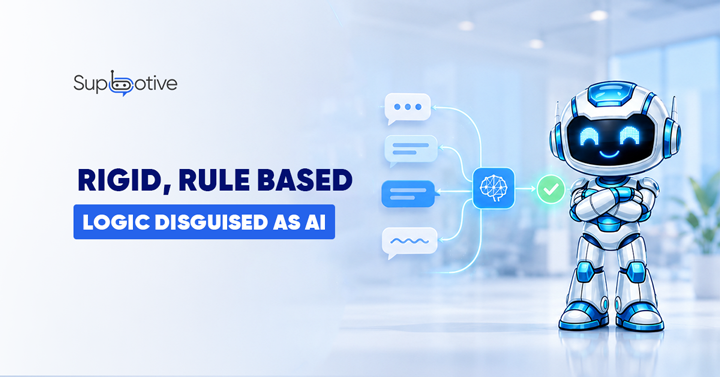
Many platforms marketed as "AI chatbots" are really decision trees with a chat interface on top. They work fine as long as the customer’s question matches a preprogrammed path. The moment it does not, the bot breaks.
This is different from a genuine AI chatbot using natural language processing, which understands intent regardless of how a question is phrased. Rule based systems cannot do this they match keywords, and when the match fails, the customer gets a menu of options that does not address their actual question.
How to fix it:
If evaluating a platform, ask directly whether it uses NLP and retrieval augmented generation (RAG or whether it is a rule based on chat styling. A genuine AI chatbot should handle "can I send this back?" and "What’s your return policy?" identically both expressing the same intent in different words.
4. Deployed on the Wrong Channel
A chatbot built for website chat widgets does nothing for a business whose customers primarily message on WhatsApp. This sounds obvious, but it is a remarkably common mistake businesses adopt whichever chatbot tool is easiest to set up, rather than the one that matches where their customers actually are.
AI in ecommerce support can massively improve efficiency and customer experience if implemented correctly. The "if implemented correctly" part frequently means channel fit, not just technical setup.
How to fix it:
Identify your primary customer contact channel before choosing a platform. If most queries arrive on WhatsApp, the chatbot needs to be built for WhatsApp. Specifically, not a generic tool with a WhatsApp integration bolted on as an afterthought.
5. No Feedback Loop the Same Gaps Repeat Forever
A chatbot that launches and is never reviewed again stops improving the day it goes live. Ignoring analytics after deployment is consistently named among the top reasons chatbots fail.
Winning deployments are built as connected systems designed to improve continuously based on real interactions, not static tools left untouched after launch. Without a structured review process, the same unanswered questions appear week after week, and the resolution rate never climbs above whatever it started at.
How to fix it:
Track four metrics from day one resolution rate, customer satisfaction, dropoff rate, and escalation rate. If the resolution rate sits below 40% or satisfaction is declining, the chatbot needs attention immediately. Review escalated and unanswered conversations weekly, add the missing answers to the knowledge base, and watch the resolution rate climb over each cycle.
6. No Sentiment Awareness
A frustrated customer typing in capital letters gets the exact same flat, cheerful response as someone asking a simple shipping question. This mismatch is one of the fastest ways to make a bad situation worse.
AI hallucinations confidently providing incorrect information account for 22% of AI failure instances. When that wrong information is delivered to an already frustrated customer with no escalation in sight, the damage compounds quickly.
How to fix it:
Modern AI chatbots can run sentiment analysis in the background, detecting frustration signals urgency, negative language, repeated contact and triggering immediate escalation regardless of whether the query is technically answerable. A businesslike, calm response to an angry customer is not enough; the system needs to recognize the emotional state and act on it.
7. Treated as a "Set and Forget" Launch
The biggest mistake companies make is treating chatbots as a cost-cutting substitute for human agents rather than a force multiplier for them. This mindset leads directly to chatbots being launched once and left alone no documentation updates, no monitoring, no ownership.
Trying to handle every question from day one is itself a common failure pattern businesses launch with overly broad scope instead of starting narrow and expanding deliberately.
How to fix it:
Assign clear ownership of the chatbot to postlaunch someone on the team responsible for reviewing performance weekly. Start with a narrow scope covering your highest volume queries, prove it works, then expand. A chatbot that improves steadily over three months will outperform one that launched broad and was never touched again.
What Chatbots Are Actually Good at and What They Are Not
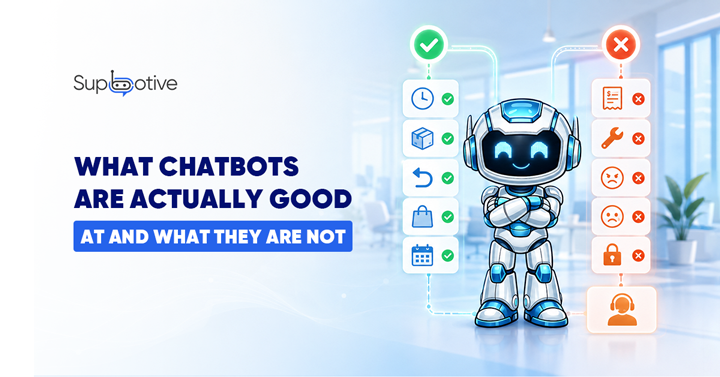
AI handles repetitive, factual questions well: business hours, order status policy, return policies, product information, and scheduling. Humans should handle billing disputes, technical troubleshooting, complaints from upset customers, and any situation requiring empathy or system access.
This distinction is the foundation every fix above depends on. A chatbot is not failing because it cannot solve every problem it fails when it is asked to solve problems it was never designed to solve, with no path to hand off the ones it cannot.
How Supbotive Avoids These Seven Failure Points
Supbotive is built around the specific failure patterns above, not despite them.
It trains directly on your real documentation FAQs, policies, product guides so the knowledge base starts substantive, not thin. It uses genuine NLP rather than rigid decision trees, so varied phrasing of the same question is understood correctly. It is purpose built for WhatsApp and Telegram the channels where most support conversations actually happen rather than a generic tool with messaging bolted on.
Smart escalation is core to the design, not an afterthought: when the bot cannot answer confidently, it hands off to a human agent with the full conversation history attached. Every unanswered question is flagged automatically, closing the feedback loop without requiring anyone to dig through logs manually.
Worried your current chatbot setup has some of these problems? Book a live demo with Supbotive and see how a properly structured knowledge base and smart escalation actually work in practice.