
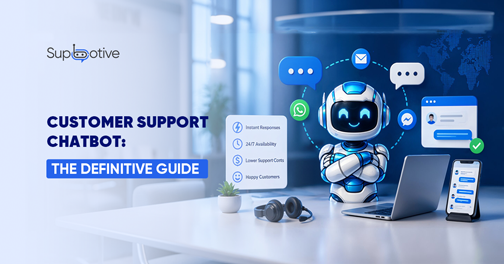
Businesses use customer support chatbots to reduce response times, lower support costs, and deliver 24/7 service without expanding their team.
What Is a Customer Support Chatbot?
A customer support chatbot is an AI driven software tool that automates customer service interactions by understanding customer questions, retrieving answers from a knowledge base, and responding in real time without requiring a human agent for every message.
Unlike basic FAQ widgets or scripted menu bots, modern customer service chatbots use natural language processing (NLP) and machine learning to understand what customers actually mean, not just the keywords they type. A customer asking “my order hasn’t arrived” and another asking “where’s my package?” are asking the same thing and a well built customer support chatbot recognizes both.
When a query falls outside the chatbot’s knowledge, it escalates the conversation to a human support agent with the full conversation history intact, so customers never have to repeat themselves.
Why Customer Support Chatbots Matter in 2026
Customer expectations have changed permanently. According to Salesforce’s State of Service report, around 77% of customers expect to interact with someone immediately when they contact a business. At the same time, support teams are managing higher message volumes than ever particularly across messaging platforms like WhatsApp and Telegram.
The result is a gap that human only support cannot close at scale.
- The global chatbot market is projected to grow to $23 billion by 2030 (Africa Business Communities).
- AI powered chatbot technology for customer service could reduce contact center labor costs by $80 billion by the end of 2026 (Gartner)
These are not experimental numbers they reflect businesses that have already made customer support automation core infrastructure.
For businesses still managing every message manually, the cost is not just financial. It is slower response times, inconsistent answers, and support agents spending most of their day answering the same five questions.
How Does a Customer Support Chatbot Work?
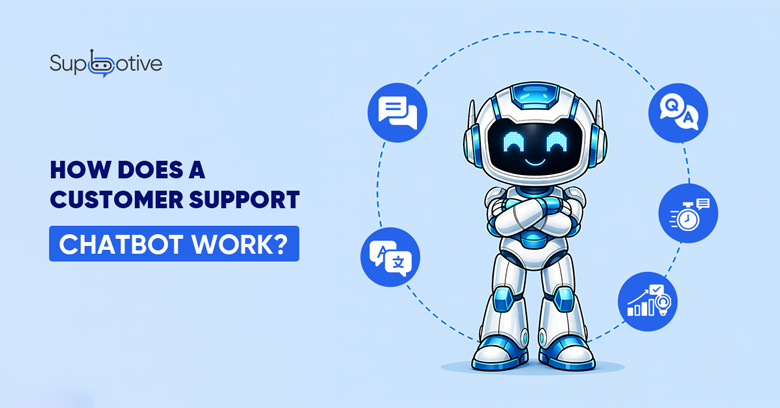
Step 1: The Customer Sends a Message
The client enters a query via WhatsApp, Telegram, an online chat widget, or some other medium. The message gets into the chatbot system.
Step 2: Natural Language Processing Interprets the Query
The NLP engine of the chatbot interprets the message and recognizes intent. This is an extension of keyword matching. NLP enables the chatbot to comprehend different wording, context and even ambiguous questions.
I want a refund and this is not what I ordered can both initiate a returns workflow since the chatbot knows the underlying intent, rather than the literal words.
Step 3: The Knowledge Base Is Searched
After identification of intent, the chatbot looks up its knowledge base a structured repository of frequently asked questions, product documentation, policies and internal guides to find the most precise, relevant answer.
Step 4: The Response Is Delivered
The chatbot provides a prompt, uniform response. This solves the conversation in simple queries. In more complicated cases, the chatbot steps through a guided workflow by putting clarifying questions, gathering information, or guiding the customer to the appropriate next step.
Step 5: Smart Escalation When Needed
he query may be considered to be too complicated, too sensitive, or even beyond the knowledge of the chatbot and be redirected to a human support agent. Importantly, the entire history of conversation is relayed through to ensure that the agent obtains all the context and a customer is never required to repeat his or her problem.
This automation first, human when necessary model is what separates effective customer support chatbot deployments from frustrating ones.
What Can a Customer Service Chatbot Actually Do?
Practical uses of an effective customer service chatbot go well beyond responding to FAQs. This is what they are used by businesses to do:
Instant Query Resolution
Quick Response to Query most of the inbound support queries are repeated. Status of the order, price, and so on, a customer support chatbot can manage all these immediately, at any time, and without the line.
This automation first, human when necessary model is what separates effective customer support chatbot deployments from frustrating ones.
Guided Conversation Workflows
The chatbot will not provide an answer, but rather guide the customer through a structured workflow where they enter information, confirm details, and the chatbot takes the conversation towards a resolution step by step.
Knowledge Base Management
Chatbots answers that are drawn to a company’s existing documentation. Once that documentation is updated, it automatically updates the responses of the chatbot without the need to reprogram it manually.
Human Escalation with Context
When a query involves a human agent, the chatbot forwards all the conversation history. The agent is aware of what the customer requested, what the chatbot recommended, and what remains to be solved.
Message Tracking and Visibility.
All the customer interactions are tracked. The support managers are able to track the unresolved discussions, recognize the frequent questions that require improved responses, and see the patterns that are indicative of the product or service issues before they get out of control.
Continuous Self Learning
When an AI based customer service chatbot cannot answer a question, it is answered by a human. That response is then appended to the body of knowledge. The chatbot automatically processes the same question the next time the same question is presented.
This is a feedback loop so that the system shows improvement with time in a measurable way.
Key Benefits of Customer Support Chatbots for Businesses
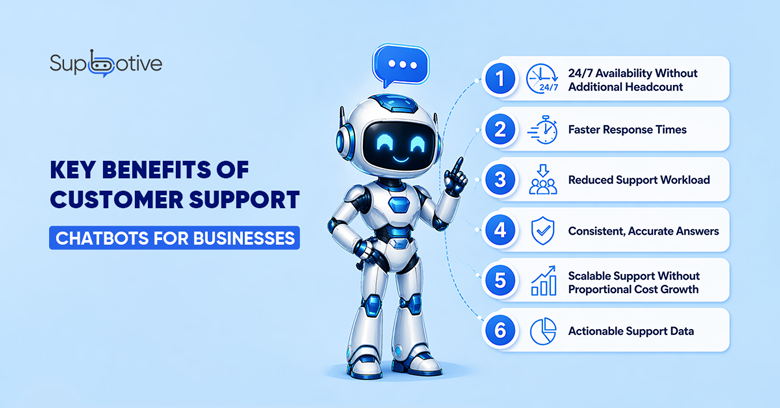
1. 24/7 Availability Without Additional Headcount
A chatbot of customer care is a 24/7 support system. The way to reach out to customers in various time zones, outside of business hours, or on weekends is the same immediate response as those calling during peak hours, but at no extra staffing cost.
2. Faster Response Times
One of the most monitored customer service measures is response time. Chatbot replies can be automated and immediate.
It has been demonstrated that AI assisted support tackles problems 47 times faster than human alone solutions, and 25 times more often than first contact solutions.
3. Reduced Support Workload
Where repetitive questions are being answered by a chatbot about customer service, human agents are liberated to deal with complex and high value interactions that actually demand judgment and empathy.
Companies using chatbots alongside human operators have been shown to support 7.7 percent more simultaneous conversations and have also cut staffing expenses.
4. Consistent, Accurate Answers
Answers to human agents under pressure are inconsistent. A chatbot customer support service programmed based on a current knowledge base will provide the same correct answer each time, no matter the number of messages sent or the time of the day.
5. Scalable Support Without Proportional Cost Growth
Hiring grows linearly. Capacity of chatbot does not. When a business doubles its customers, it is not necessary to increase its customer support team when its chatbot customer service can easily cope with the standard number of customers.
The AI powered self service can address up to 60% of support tickets, eliminating much of the repetitive workload in the agent’s queues.
6. Actionable Support Data
Each chatbot dialogue generates structured data. Businesses are able to tell what questions are the most frequently asked, which workflows have the highest drop off rates.
Areas of the product that are the most confusing and create intelligence that is useful in improving the support system as well as the product itself.
What Makes an AI Powered Chatbot for Customer Service Effective?
Not all chatbots implementation is fruitful. The distinction between a working system and one that exasperates customers is reduced to a handful of factors.
1. Knowledge Base Quality
The chatbot can be as accurate as the things it is trained on. A database containing actual FAQs, internal documentation and previous customer requests yield accurate, up to date responses. Superficial or stagnant knowledge base yields vague ones.
2. Smart Escalation Design
The automation is not as important as the escalation path. In case the chatbot is not able to solve a problem, the transition to the human agent should be seamless and all the context should be saved and no disruption to the customer experience.
3. Channel Integration
WhatsApp and Telegram are the most popular messaging applications that customers use. A customer service chatbot based on AI must not be used to redirect customers to a different channel.
4. Continuous Improvement Loop
Optimally, the best customer service chatbot systems get better with time. Questions that remain unanswered are raised to agents, their answers are obtained and they are included in the knowledge base. The resolution rate of the chatbot is increased with each cycle without human intervention.
5. Visibility and Tracking
Businesses should be able to view the activities of their chatbot. What are the unresolved conversations? What are the questions that are recurring?
What is the rate of growth? In the absence of such visibility, teams are unable to detect gaps or gauge improvement.
Which Channels Do Customer Service Chatbots Work On?
The modern customer service chatbots are not restricted to chat boxes on websites. The best deployments work on the messaging platforms on which customers already communicate:
1. WhatsApp
WhatsApp is the leading customer communication channel in businesses in Europe, Asia, Middle East, and Latin America with more than 2 billion active users in the world.
An example of a WhatsApp chatbot is an immediate response to incoming messages, customer directed workflows, and the ability to refer customers to agents, all in the same app that customers already use every day.
2. Telegram
The open API and group communication features of Telegram make it especially useful in businesses that have active communities or a high volume of inbound messaging. A Telegram bot processes queries in quantity, supports the structure of conversations, and combines with support processes.
3. Website Live Chat
The oldest channel which is integrated directly in an organization web site to capture visitors who are going away by asking them questions.
4. Email and SMS
Chatbot automation is expanded to email and SMS, and many businesses, but the dynamics of responses are not the same as real time messaging.
How Supbotive Delivers AI Powered Customer Support Chatbot Technology
Supbotive is a chatbot customer service AI agent that is specialized in WhatsApp and Telegram. It learns based on what you already have in business documentation like FAQs, internal help desk guides and product pages to provide immediate and correct responses to customer questions.
In case a question is beyond the knowledge base, Supbotive forwards the question to a human support agent with the entire history of the conversation.
The distinguishing feature of Supbotive is its inbuilt structure and visibility. Each discussion is logged, pending questions are highlighted and questions asked over and over again automatically assisting a team to constantly enhance its customer service chatbot as time goes on.
The outcome is to provide faster support, reduce the workload of agents, and full human control at the point where it counts.
Common Mistakes Businesses Make with Customer Service Chatbots
1. Deploying without a solid knowledge base
A chatbot trained on thin or old information provides incorrect responses. Real customer questions past support tickets are better sources of knowledge base to be built before deployment.
2. Removing the human escalation path
Complete automation is efficient but it undermines customer confidence in case of complicated situations. All chatbots in customer services should have a clear smooth way to a human agent.
3. Not measuring performance
Implementing a chatbot without monitored rate of resolution, escalation, and customer satisfaction implies there is no chance of improving it. Established pre launch baselines.
4. Treating the chatbot as a onetime setup
Bots that provide customer service become better in case teams contribute to the knowledge base. In the absence of a continuous improvement process, the system remains stagnant and customer queries change.
5. Choosing the wrong channel
An online chat bot created to chat on your site, but used by no one, is a waste of money. Place on the channels that your customers are in touch with you.
Conclusion
Customer support chatbot does not take the place of human service, just works as a multiplier of the same. Combined with a robust knowledge foundation and intelligent escalation,
it answers routine requests in real time and liberates agents to work on tasks that demand real human attention.
The companies that are experiencing the greatest influence are not the ones that have the most advanced AI. They have the best knowledge bases and a process of continuous improvement.
When your team is doing high volume messaging on WhatsApp or Telegram, a customer support chatbot represents your closest road to scalable customer support.
FAQs:
1. What is a customer support chatbot?
It uses natural language processing to understand customer intent and retrieves answers from a knowledge base. It provides instant, 24/7 support while escalating to human agents when needed.
2. What is a customer service chatbot and how is it different from a support bot?
Customer service covers a broader scope like onboarding, while “customer support” focuses on post-purchase interactions. In practice, most businesses use both terms interchangeably.
3. What is the best AI chatbot for customer service?
Generic chatbot builders require significantly more custom development to match the same results.
4. What is an AI powered chatbot for customer service?
Unlike rule based bots, it handles varied phrasing, multi turn conversations, and complex queries. It improves its accuracy automatically with every interaction processed.
5. What chatbot technology for customer service is best for small businesses?
No code platforms that train existing FAQs and documentation without requiring a developer are the most practical starting point. Smart escalation ensures that a small team is never overwhelmed.
6. Do customer service chatbots replace human agents?
7. How do customer service chatbots handle questions they cannot answer?
That resolved answer is then added to the knowledge base for future automation. This continuous improvement loop raises the chatbot’s resolution rate over time.