

As businesses expand into new markets, customer support becomes increasingly complex. A company that once served customers in a single language may suddenly receive enquiries in Spanish, French, German, Arabic, or dozens of other languages through channels like WhatsApp, Telegram, live chat, and email.
Hiring native-speaking support agents for every language is rarely practical. It increases operational costs, complicates scheduling, and makes it difficult to provide consistent support around the clock.
At the same time, customers expect businesses to communicate in their preferred language. If they cannot understand the response—or if the response is inaccurate—they quickly lose confidence in the business.
This is where a multilingual customer support chatbot can make a significant difference.
However, many people misunderstand how these systems work. A modern AI chatbot does much more than translating text. When connected to a structured knowledge base, it can understand customer intent, retrieve business-specific information, and deliver accurate responses while maintaining the meaning of your company’s policies, products, and procedures.
Understanding this difference is essential for businesses that want to scale customer support without sacrificing quality.
Why Multilingual Customer Support Is Challenging
Supporting customers in multiple languages involves more than translating words.
Every language introduces new operational challenges that businesses must manage consistently across every support channel.
1. Different Customers Speak Different Languages
Businesses rarely know which language a customer will use when starting a conversation.
For example, a UK ecommerce business may receive enquiries in English, Polish, French, or German from customers living across Europe. A real estate agency might communicate with international buyers who prefer their native language. Educational institutions often support students from multiple countries at the same time.
Without multilingual support, response times increase while customer satisfaction declines.
2. Limited Support Resources
Building multilingual support teams requires hiring agents with different language skills, training them on company policies, and ensuring coverage during holidays, weekends, and different time zones.
For many small and medium-sized businesses, this simply isn’t scalable.
As customer enquiries increase, maintaining consistent service becomes even more difficult.
3. Inconsistent Responses Across Languages
One of the most common operational problems isn’t translation—it’s consistency.
Different agents may explain the same refund policy differently. One support representative may provide additional information, while another gives only a brief response. Over time, customers begin receiving inconsistent answers depending on who handles their conversation.
This inconsistency creates confusion and reduces trust.
4. Maintaining Business Knowledge
- Business information changes constantly.
- Pricing changes.
- Services evolve.
- Policies are updated.
- New products are launched.
If every language version of your documentation isn’t updated at the same time, customers may receive outdated or conflicting information.
This is why multilingual support depends as much on knowledge management as it does on language capabilities.
How a Multilingual Customer Support Chatbot Works
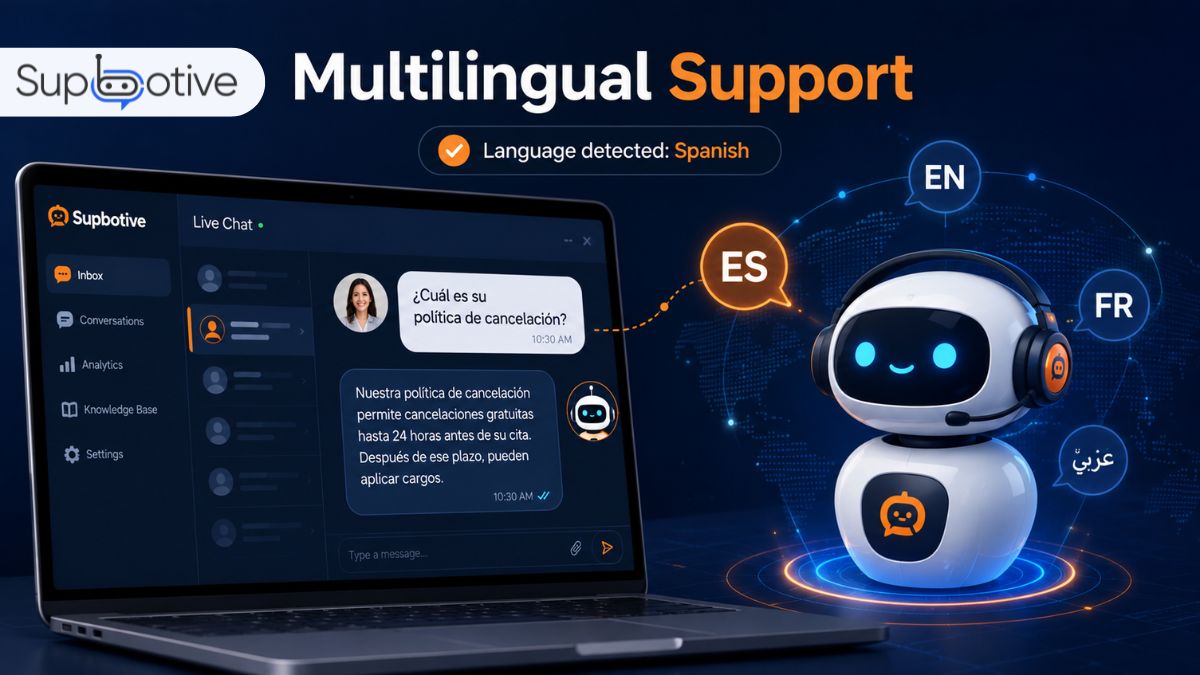
Modern customer support chatbots follow a structured process designed to deliver accurate information rather than simply translating customer messages.
1. Detecting the Customer’s Language
The first step is automatic language detection.
When a customer sends a message, the AI analyses the text to determine which language is being used. This happens almost instantly and requires no manual input from either the customer or the support team.
For example, if a customer writes:
“¿Cuál es su política de cancelación?”
The chatbot recognizes that the conversation is in Spanish and continues communicating in Spanish without asking the customer to change language settings.
This creates a smoother customer experience and removes unnecessary friction at the beginning of the conversation.
2. Understanding Customer Intent
Identifying the language is only the first step.
The more important task is understanding what the customer actually wants.
Modern AI customer support chatbots use natural language processing (NLP) to identify the customer’s intent rather than matching exact keywords.
For example, consider these two enquiries:
“I want to return my order.”
“How do I change my booking?”
Although both messages involve customer requests, they represent completely different support workflows.
The chatbot identifies whether the customer needs information about returns, bookings, cancellations, pricing, technical support, documentation, or another business process.
This allows the system to retrieve the most relevant information instead of providing generic responses.
3. Searching the Business Knowledge Base
This is where many businesses misunderstand AI chatbots.
A high-quality customer support chatbot should not rely solely on the AI model’s general knowledge.
Instead, it should search your business’s own knowledge base before generating a response.
A well-maintained knowledge base typically includes:
- Frequently asked questions (FAQs)
- Product and service documentation
- Company policies
- Pricing information
- Internal support procedures
- Troubleshooting guides
- Business processes
- Customer onboarding documentation
Rather than guessing an answer, the chatbot retrieves the most relevant information from these approved resources.
This significantly improves response accuracy while ensuring customers receive information that reflects how your business actually operates.
4. Responding in the Customer’s Preferred Language
Once the chatbot retrieves the correct information, it generates a response in the customer’s preferred language.
More importantly, it preserves the meaning of your original documentation.
For example, if your refund policy specifies that cancellations are accepted within 14 days, the chatbot communicates that exact policy regardless of whether the customer asks in English, French, German, or Spanish.
The objective isn’t simply translating words.
It delivers accurate business information in a language the customer understands.
When implemented correctly, this approach creates consistent support experiences across every language your business supports.