

Poor customer service costs global businesses an estimated $3.7 trillion every year. In the UK alone, service failures cost organizations £7.3 billion every month. Most of that cost is invisible because 56% of unhappy customers never complain before leaving. They simply stop buying and tell others not to either.
The Number That Should Change How You Think About Support
Most business owners think about customer support as a cost. Something to minimize. A team to keep small.
That framing is backwards, and it is expensive.
Poor customer service costs global businesses an estimated $3.7 trillion in lost revenue every year. In the UK specifically, research from the Institute of Customer Service found that service failures are costing UK organizations an estimated £7.3 billion every month driven in part by the finding that 64% of employees spend a portion of their working time dealing with problems caused by service breakdowns (Institute of Customer Service.
That is not a problem confined to large corporations. Smaller businesses are often more vulnerable to service failures because they rely heavily on repeating custom and word-of-mouth recommendation.
The number that makes this most alarming is not the headline figure. It is this: 56% of unhappy customers leave without ever filing a complaint. They do not give you a chance to fix it. They just go.
Most businesses only measure the complaints they receive. The real cost is in the customers they never hear from.
The Direct Costs What You Can Actually Measure
1. Customer Churn
72% of customers switch to a competitor after one bad interaction. 32% will walk away from a brand they love after a single negative experience. Separately, 51% of consumers reduce or stop spending after a negative experience and the cumulative revenue at risk grew 19% year over year.
Every customer who leaves takes more than their next purchase with them. They take every future purchase they would have made, and that is what customer lifetime value (CLV) measures. For a business with an average CLV of £340 (four purchases per year at £85 each), one lost customer does not cost £85. It cost £340. Or more, depending on how long they would have stayed.
2. The Word-of-mouth Multiplier
A satisfied customer tells approximately 9 people about a good experience. An unhappy customer says. On social media, that number has no ceiling.
92% of UK consumers have had a poor customer experience, and one in three have acted on their frustration by abandoning a purchase because they could not find the information they needed.
One unresolved complaint shared publicly can reach an audience that would have taken months to build organically. The DPD chatbot case where an AI began swearing at a customer and composing a poem criticizing the company went viral within hours and forced an immediate public apology. The reputational cost was impossible to quantify and impossible to undo.
3. The Acquisition Cost Trap
Retaining existing customer costs, on average, five times less than acquiring a new one.
Businesses with high churn from poor service are not just losing customers. They are paying to replace them constantly. Marketing spends, sales effort, onboarding time all of it repeated, for a customer base that keeps leaking out the back door while new ones are brought in the front.
The Hidden Costs What Most Businesses Never Calculate
This is where most competitor articles on this topic fall short. They stop at churn and reputation. The real cost is deeper.
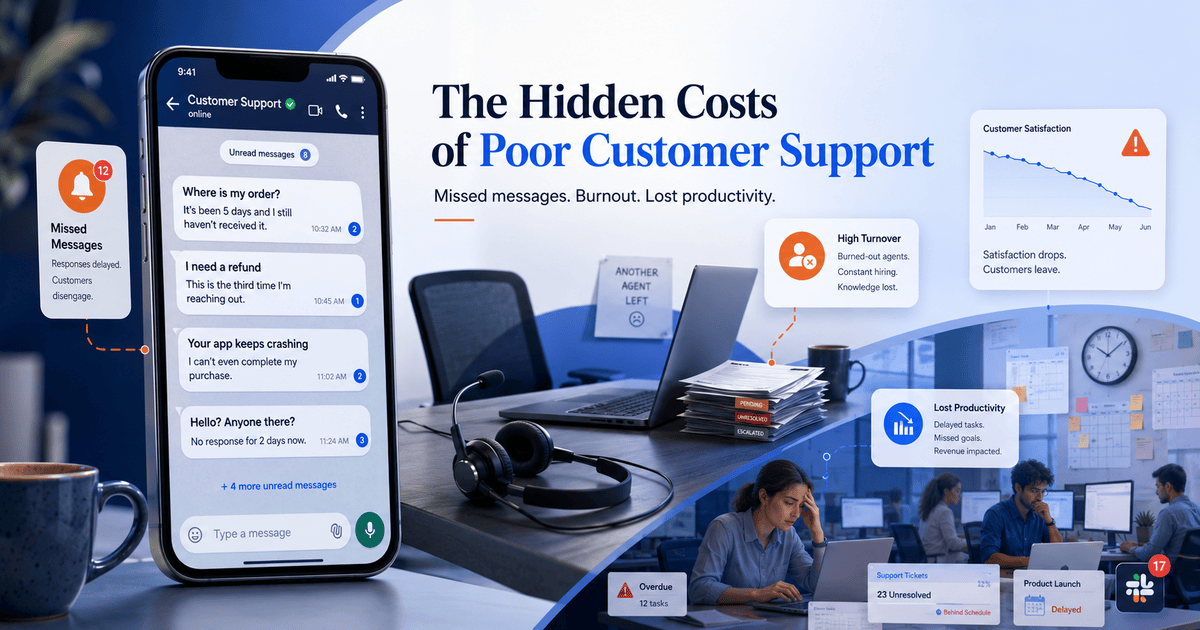
1. Missed Messages on WhatsApp
71% of consumers would consider moving to a competitor if they had to repeat their query to multiple agents. 32% would go to a different business straight away if a company did not meet their expectations for response time.
For UK businesses specifically, WhatsApp is where those expectations play out. 73% of UK consumers message businesses on WhatsApp daily. 67% expect a response within two hours.
Every unanswered WhatsApp message is not just a missed reply. It is a potential missed sale, a potential lost customer, and a potential negative review all from a single unread notification.
2. Agent Burnout and Recruitment Cost
Contact Centre turnover sits at 3045% annually, with each lost agent costing $12,000$35,000 to replace. 64% of employees spend a portion of their working time dealing with problems caused by service breakdowns (Institute of Customer Service, 2025).
When those breakdowns include answering the same five questions on repeat, all day, burnout follows. The best agents, the ones who could handle complex cases leave first, because they are the ones with options.
High agent turnover creates a perpetual training overhead, inconsistent service quality, and a team that never reaches its potential because new joiners never have time to find their footing before the next wave of departures.
3. Lost Productivity Across the Whole Business
Employees spend an average of 4.8 working days a month dealing with customer problems, costing UK businesses an estimated £11.4 billion a month in lost productivity.
This cost extends beyond the support team’s budget. Founders answering support messages instead of building the business. Sales teams are fielding complaints that should go to support. Operations staff pulled into customer issues that an automated system could have handled in seconds.
The UK Specific Numbers Every Business Owner Needs to See
Most articles on this topic are written for a US audience. The UK picture is distinct and in some ways more urgent.
The Institute of Customer Service’s UK Customer Satisfaction Index (UKCSI) puts the cost of poor service at £7.3 billion per month (Institute of Customer Service, 2025). Separately, poor customer experience is costing UK brands at least £234 billion a year as customers abandon online purchases and take their business elsewhere (Magnetic North).
Around a third of UK consumers say they are willing to pay more for excellent service, even in the context of ongoing cost pressures. For premium positioned businesses, service quality is part of the product.
UK businesses also face a compliance layer that adds financial risk to reputational risk. GDPR violations related to customer data handling, including automated customer service systems, can result in ICO fines of up to £17 million or 4% of global annual turnover. Poor customer service that leads to data mishandling complaints is not just a reputation problem. It is a regulatory one.
The Real Cost Calculator Run This on Your Own Numbers
This is the section most competitor articles do not provide. Use it to calculate your actual at risk of revenue from poor customer support.
Step 1 – Monthly contact volume How many customer messages, calls, or enquiries does your business receive per month?
Step 2 – Poorly handled percentage What percentage are answered late, incorrectly, or not at all? A conservative estimate for a business without automation is 2030%.
Step 3 – Customer lifetime value Calculate: average order value × average number of purchases per year × average years a customer stays.
Step 4 – Word-of-mouth multiplier Multiply your at-risk customers by 2.6 the average number of additional people each unhappy customer influences negatively.
Worked example a typical UK ecommerce business:
- 500 monthly WhatsApp messages
- 20% handled poorly = 100 customers with a bad experience
- Average CLV of £340
- At-risk direct revenue: £34,000 per month
- Word-of-mouth reach: 100 × 2.6 = 260 additional people put off your brand
- Annual atrisk revenue from one channel: £408,000
That is the cost of poor customer support on WhatsApp alone for a business receiving 500 messages per month. Not a large business. Not a high volume. A typical UK SME.
Why the Cost Compounds And Where It Actually Starts
Poor customer support is almost never a team problem. It is a system problem.
Businesses that fail to resolve complaints efficiently face higher customer acquisition costs because they are constantly replacing lost customers rather than growing their base. This creates a perpetual cycle of spending more to stand still (G&G Worldwide, 2026).
The compounding effect works like this:
One bad experience → customer leaves → negative review posted → prospective customer chooses competitor → support agent handles complaint fallout → burnout → agent leaves → replacement hired → inconsistent service quality → more bad experiences → more churn.
At the center of this cycle, for most UK SMEs, is a simple operational problem: too many routine queries handled manually, by people, at a speed and consistency that cannot scale.
The fix is not hiring more people. Hiring grows linearly. The volume of customer enquiries is not.
What Businesses Are Doing About It in 2026
The organizations winning in 2026 are augmenting human agents with AI tools not replacing agent capacity with automation (Digital Minds BPO, 2026). Companies see an average $3.50 return for every $1 invested in AI customer service. Cost per interaction typically drops around 68% after deployment from roughly $4.60 to $1.45 (Ringly.io, 2026).
The model that works is not full of automation. It is automation first, human when necessary. Routine, policy-based queries shipping information, return policies, product availability, payment questions handled automatically, instantly, from a knowledge base. Complex, sensitive, or emotionally charged cases escalated to a human agent with the full conversation history attached.
For UK businesses managing customer contact on WhatsApp and Telegram, Supbotive is built specifically for this use case. You upload your existing FAQs and policies, and it starts handling routine WhatsApp queries automatically giving instant, consistent answers while flagging every unanswered question for your team to close. Complex queries escalate with full context. Nothing falls through the gaps.
The businesses reducing their customer service cost in 2026 are not the ones hiring the most. They are the ones automating the right things and keeping humans for the work that genuinely needs them.
FAQs
How much does poor customer service cost for UK businesses?
Poor customer service costs UK organizations an estimated £7.3 billion each month and contributes to billions of lost sales through abandoned purchases and customer churn.
What is the global cost of poor customer service?
Poor customer service is estimated to cost businesses worldwide around $3.7 trillion in lost revenue each year.
How does poor customer service affect revenue?
It increases customer churn, lowers lifetime value, raises acquisition costs, and reduces referrals. Even one bad interaction can push customers toward a competitor.
What is the biggest hidden cost of bad support?
Agent burnout and turnover are major hidden costs. Businesses also lose productivity when employees spend time resolving repeated service failures.
How can businesses reduce these costs?
Automating routine queries with AI can reduce response times, prevent missed messages, and allow human agents to focus on complex customer issues.