
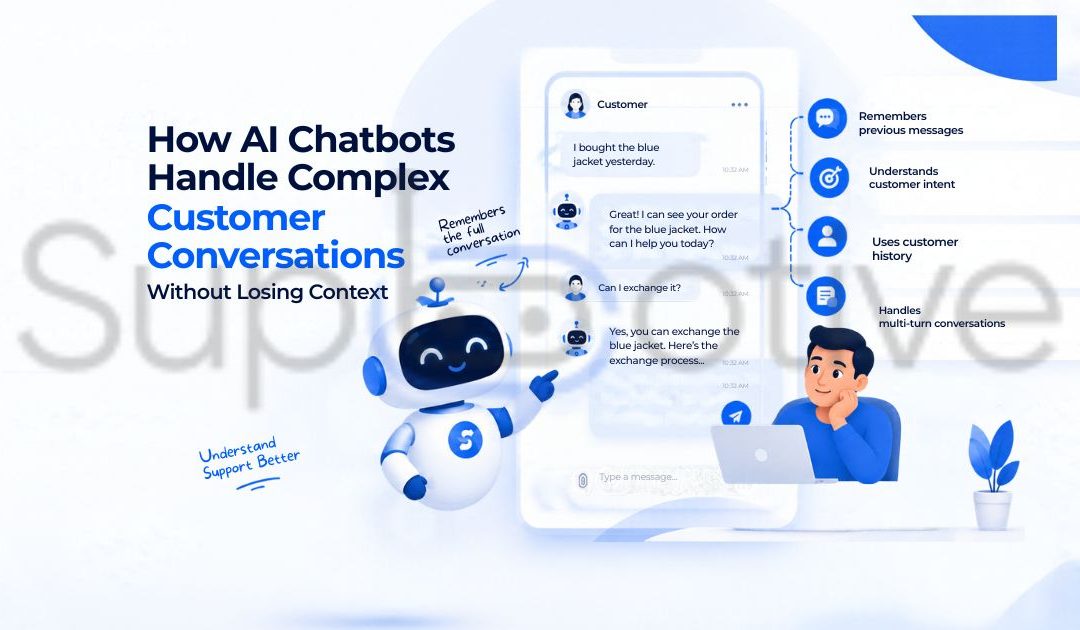
An AI chatbot maintains conversation context by remembering previous messages, understanding customer intent, tracking conversation history, and using relevant customer information to provide accurate responses across multiple interactions.
Unlike traditional chatbots that treat every message as a separate question, modern AI customer support systems understand the complete conversation. This allows customers to continue naturally without repeating information and helps businesses deliver faster, more accurate support.
For customer service teams, context is one of the biggest differences between a basic chatbot and a context-aware AI chatbot. A system that understands the conversation can resolve more queries automatically while knowing when human support is needed.
Why Conversation Context Matters
Customers rarely ask questions in isolation. Most support conversations are a series of connected messages where every question depends on previous information.
For example, a customer may first say:
“I bought the blue jacket yesterday.”
Later, they ask:
“Can I exchange it?”
A basic chatbot without context may not understand what “it” refers to. It may ask unnecessary questions or provide an unrelated answer.
A context-aware chatbot understands that the customer is referring to the blue jacket mentioned earlier. It can continue the conversation naturally and provide a more relevant response.
Conversation context improves:
- Customer experience
- Support accuracy
- Resolution speed
- Customer satisfaction
- Agent productivity
This is why modern AI customer support is moving beyond simple question-and-answer bots toward intelligent systems that understand conversations.
How AI Chatbots Understand Context
AI chatbots use multiple technologies to understand what customers mean, not just what they type. This includes conversation memory, natural language understanding, intent tracking, and customer history.
The goal is simple: understand the complete situation before generating a response.
1. Conversation Memory
AI chatbot memory allows systems to store and use relevant information from previous messages during a conversation.
This information may include:
- Product mentioned by the customer
- Current support issue
- Previous answers provided
- Customer preferences
- Current request
There are two common types of chatbot memory.
a. Short-Term Memory
Short-term memory refers to information from the current conversation.
For example, a customer asks about a specific order and later asks about a refund. The chatbot uses the earlier messages to understand that the refund question relates to the same order.
b. Long-Term Memory
Long-term memory refers to information stored from previous interactions where appropriate.
Examples include previous support history, customer preferences, or commonly requested information.
However, good AI customer support systems do not remember everything automatically. They should only store relevant information according to business rules and privacy requirements.
2. Understanding Previous Messages
AI chatbots do not only analyse the latest customer message. They look at previous messages, conversation flow, and related information to understand the complete request.
For example:
Customer: "My delivery hasn’t arrived."
Previous message:
"Your order #4582 was shipped yesterday."
A context-aware chatbot understands that the customer is asking about that specific order rather than a general delivery question.
This prevents unnecessary clarification questions and creates a smoother customer experience.
3. Intent Tracking
Intent tracking helps AI understand what the customer is trying to achieve during a conversation.
Customers often ask different questions that are connected to the same problem.
Example:
Customer: "I want to know your return policy."
Later: "Do I need the original packaging?"
A chatbot with proper intent tracking understands that both questions relate to returns.
Intent recognition helps AI systems:
- Identify customer goals
- Follow conversation topics
- Understand changing requests
- Provide relevant answers
Multi-Turn Conversations in AI Support
A multi-turn AI conversation happens when a customer and chatbot exchange multiple messages while maintaining the same context.
This is how real human conversations work. People do not repeat everything every time they ask a follow-up question.
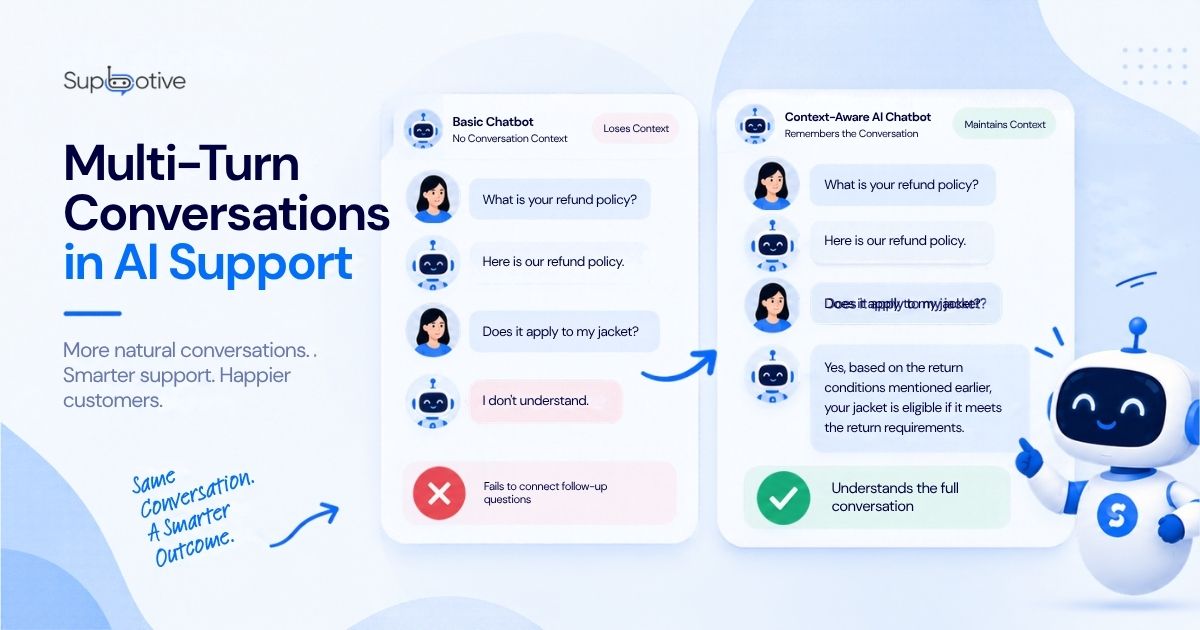
A basic chatbot may work like this:
Customer: “What is your refund policy?”
Bot: “Here is our refund policy.”
Customer: “Does it apply to my jacket?”
Bot: “I don’t understand.”
The chatbot fails because it cannot connect the second question with the previous conversation.
A context-aware AI chatbot understands the relationship:
Customer: “What is your refund policy?”
Bot: “Here is our refund policy.”
Customer: “Does it apply to my jacket?”
Bot: “Yes, based on the return conditions mentioned earlier, your jacket is eligible if it meets the return requirements.”
This creates a more natural support experience.
Handling Context Switching
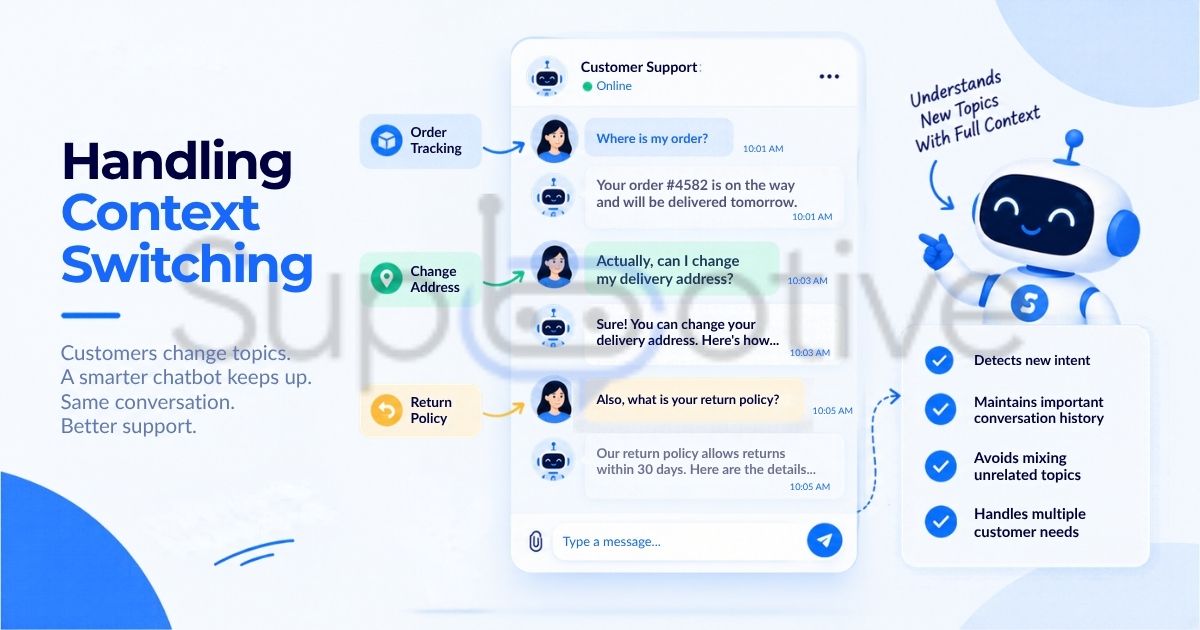
Customers do not always follow a straight conversation path. They often change topics while chatting with support.
For example:
Customer:
- "Where is my order?"
- "Actually, can I change my delivery address?"
- "Also, what is your return policy?"
A capable AI chatbot must understand these changes without losing previous information.
It needs to:
- Detect the new intent
- Maintain important conversation history
- Avoid mixing unrelated topics
- Handle multiple customer needs
Context switching is important because real customers do not communicate in perfectly structured conversations. AI customer support systems need to adapt to natural human behaviour.
Using Customer History for Better Support
Customer history helps AI provide more personalised and efficient support.
Relevant customer information may include:
- Previous conversations
- Past issues
- Previous purchases
- Common questions
- Escalation history
This creates several benefits.
1. Faster Resolutions
The AI or support agent already understands the customer’s background, reducing investigation time.
2. Personalised Support
Customers receive responses based on their previous interactions rather than generic answers.
3. Reduced Repetition
Customers do not need to explain the same problem multiple times.
However, businesses must handle customer information responsibly. Data storage, access, and usage should follow applicable privacy requirements.
When AI Chatbots Lose Context
When an AI chatbot loses context, the customer experience quickly declines.
Common problems include:
1.Customers Repeat Information
Customers become frustrated when they have to explain the same issue again.
Example:
"I already explained this earlier."
2. Wrong Answers
Without context, AI may misunderstand the actual customer problem and provide irrelevant information.
3. Poor Escalation
If the chatbot transfers a conversation without context, human agents must start from the beginning.
4. Lower Trust
Customers may feel they are interacting with a basic automated system rather than intelligent support.
Context management is one of the key factors in separating advanced AI support systems from traditional chatbots.
How Supbotive Maintains Conversation Context
Supbotive uses context-aware AI support to understand customer conversations across WhatsApp, Telegram, and website chat.
The system combines:
- Conversation history
- Intent understanding
- Knowledge base retrieval
- Smart escalation
- Full conversation transfer to agents
For example, a customer may first ask about a product and later ask about returns. Instead of treating these as separate questions, Supbotive can use conversation context to understand that both requests are connected.
When a conversation requires human assistance, the complete history can be transferred so the customer does not need to repeat the issue.
Context Management vs Conversation Memory
|
Context Management |
Conversation Memory |
|
Understands the current conversation |
Remembers previous information |
|
Focuses on meaning and relevance |
Focuses on stored information |
|
Usually short-term |
Can be short-term or long-term |
|
Helps answer current questions |
Helps personalise future interactions |
Both are important for effective AI customer support.
Conversation memory helps the system remember information, while context management helps the AI understand what that information means during the conversation.
Best Practices for Context-Aware AI Support
Businesses should follow a structured approach when implementing AI chatbot systems.
1. Build a Structured Knowledge Base
AI needs accurate business information to provide reliable answers. Clear FAQs, policies, and support documents improve response quality.
2. Define Remembered Information
Not every customer’s detail needs to be stored. Businesses should decide what information is useful and appropriate.
3. Test Real Conversations
Use real support examples to identify where the chatbot understands or loses context.
4. Monitor Context Failures
Review conversations where AI misunderstood customer requests and improve the system.
5. Use Human Escalation
Some conversations require judgement and empathy. AI should know when a human agent needs to take over.
Conclusion
A chatbot is not truly intelligent because it can answer questions quickly. The real difference is whether it understands the customer’s conversation behind the question.
AI chatbot conversation context improves accuracy, customer experience, resolution speed, agent productivity
The future of customer support is not only automated answers. It is AI that understands conversations, maintains context, and knows when human support is required.
FAQs
AI chatbot conversation context is the ability of an AI system to understand previous messages, customer intent, and relevant information to provide accurate responses.
AI chatbots use conversation memory and stored context to track relevant information from previous messages during and across conversations.
Context prevents customers from repeating information and helps chatbots provide more accurate and personalised answers.
Yes, AI chatbots can use customer history where appropriate, depending on business rules, privacy requirements, and system configuration.
The chatbot may provide incorrect answers, ask customers to repeat information, or fail to resolve the issue effectively.
Interested in learning more? Get in touch!
Please fill out the form below and we will get back to you shortly.