
Your support team is probably answering the same 10 questions on repeat. An e-commerce customer support chatbot takes most of that off their plate automatically, instantly, every day. Here are 50 queries to start with.
Let’s Be Honest About Ecommerce Support
Running a store is hard enough. But then add 50 messages a day asking the same things shipping times, return windows, payment options and your team start spending most of their day on stuff that doesn’t need a human at all. That’s the problem a good ecommerce chatbot solves. Not replacing your team.
By getting the boring, repetitive stuff out of their way so they can actually focus on customers who need real help. The 50 queries below cover the questions your customers ask most. Use this list to train your customer support AI chatbot for e-commerce, and you’ll notice the difference in your support queue almost immediately.
Category 1: Shipping & Delivery Questions
Shipping questions flood every ecommerce inbox. The thing is most of them aren’t complicated, customers just want to know what to expect.
They’re not asking for real time tracking data. They want to know if you ship to their country, how long it takes, whether free shipping applies to their order. These are all answered by your shipping policy. Your ecommerce customer support chatbot can handle every single one of them without a human touching the conversation.
One thing to note: Supbotive doesn’t connect to live order tracking systems. So queries asking for a specific shipment update get passed to your team. Everything below, though? Fully automated.
- How long does standard shipping take?
- Do you offer express or next-day delivery?
- How much does shipping cost?
- Do you ship internationally?
- Which countries do you deliver to?
- What courier or shipping carrier do you use?
- Can I collect my order in the store?
- Do you offer free shipping, and what’s the minimum order?
- Why has my shipping cost changed at checkout?
- Can I ship to a PO Box or business address?
Related Article: What Are the Benefits of Using AI Support Chatbots for Businesses?
Related Article: What is Customer Support Chatbot: The Definitive Guide.
Category 2: Returns, Refunds & Exchanges
Nobody contacts support happy about a return. They’re already frustrated. The last thing they want is to wait hours for a basic answer.
Most return questions follow the same pattern what’s the policy, how do I start it, how long until I get my money back. Your ecommerce chatbot can walk customers through all of that. The tricky one’s damaged items, wrong products, disputes those go to a human. But the routine stuff? Gone from your queue.
- What is your return policy?
- How do I start returning?
- How long do I have to return an item?
- When will I receive my refund?
- Can I exchange this for a different size or color?
- I got the wrong item. What do I do?
- My item arrived damaged. How do I get a replacement?
- Do I have to pay for return shipping?
- Can I return a sale item?
- I haven’t received my refund yet. Where is it?
Returns are one of the biggest sources of repeat tickets in e-commerce. Getting your chatbot to handle the standard cases cuts that volume significantly. And smart escalation means the unusual ones still reach a real person fast, with full context.
Category 3: Product Information & Availability
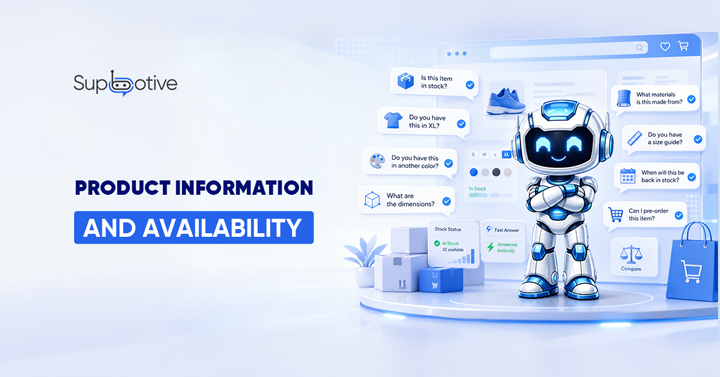
A customer support AI chatbot platform for ecommerce trained on your product catalogue answers these before the customer loses interest. Studies show chatbots that guide product discovery can lift conversion rates by 15 30%. That’s not a small number.
- Is this item in stock?
- Do you have this in a different size?
- Do you have this in a different color?
- What are the dimensions of this product?
- What materials is this product made from?
- Is this product suitable for [specific use case]?
- How does this product compare to [other product]?
- Do you have a size guide?
- When will this item be back in stock?
- Can I pre-order this item?
Category 4: Account & Order Management
These questions don’t need creative thinking. They need quick, accurate information from your policies and platforms.
A couple of things here queries like “cancel my order” or “change my delivery address” work best as a two step process. Your chatbot explains the policy and process. Then if an action needs to be taken, it hands off to your team with everything the agent needs to act fast.
- How do I create an account?
- I forgot my password how do I reset it?
- How do I update my email address?
- How do I change my delivery address?
- What is your order cancellation policy?
- How do I request an order modification?
- How do I apply for a discount code?
- My discount code isn’t working. What do I do?
- How do I view my order history?
- How do I update my payment details?
Your ecommerce chatbot for customer support gives the customer the right information instantly. When something needs a human to action it the handoff is clean, the context is already there.
Category 5: Payments, Billing & Security
Payment questions stress customers out. If someone’s unsure whether their payment went through, or worried they were charged twice, they need an answer fast.
Most of these are answered by your store’s payment policies. No guesswork, no investigation needed just clear, direct information from your documentation.
- What payment methods do you accept?
- Is it safe to pay on your website?
- Why did my payment decline?
- Was I charged twice for my order?
- Can I pay installments?
- Do you offer to buy now, pay later?
- Will I be charged with customs or import duties?
- Can I get a VAT invoice for my order?
- How do I use store credit or a gift card?
- I was charged but didn’t receive an order confirmation.
So What Do You Actually Do With This List?
Don’t try to set up all 50 at once. That’s a good way to end up with a half -built knowledge base and patchy answers.
Start by pulling your last 90 days of support tickets. Which questions showed up the most? Pick the top 10 from this list and build those out first. Write answers based on your actual policies not generic placeholders. A chatbot giving a vague answer is worse than no chatbot at all.
Then figure out your escalation points. Not everything here should stay fully automated. Damaged goods, billing disputes and missing orders need a human at some point. Decide where that line is and make the handoff seamless.
After that, just keep going. Every time your ecommerce customer support chatbot can’t answer something, review it. Add it to the knowledge base. The gap closes, the chatbot handles it next time. That’s how the system gets better week by week without you having to touch it constantly.
What If the Chatbot Gets It Wrong or Can’t Answer?
This is the question most e-commerce teams ask before they commit to automation. Fair enough. A well-built chatbot doesn’t guess. When it can’t find a confident answer in your knowledge base, it stops and passes the conversation to a human agent with the full chat history already attached. Your agent sees everything.
The customer doesn’t repeat a single word. That’s what smart escalation actually looks like in practice. Not a chatbot pretending it can handle everything. A system that knows its limits and hands off cleanly when it hits them. The chatbot handles the volume. Your team handles the nuances. Both do what they’re actually good at.
What About Outsourcing Ecommerce Customer Service?
Some store owners look at their support volume and think maybe I should just outsource ecommerce customer service entirely. It can work. But here’s the reality: outsourced agents still spend most of their time on the same 50 questions above. You’re paying people per hour to answer things that cost pennies to automate.
The setup that works best? Use a customer support AI chatbot for ecommerce on WhatsApp and Telegram to handle the high volume, repeatable stuff automatically. Then let your human agents in-house or outsourced focus on the complex cases that actually need them.
Chatbot for volume. Humans for complexity. That’s the combination that keeps costs down without dropping the quality of support.
How Supbotive Works for Ecommerce Support Teams
Supbotive is built for ecommerce businesses that get most of their customer messages through WhatsApp and Telegram.
You add your FAQs, return policies, shipping policies, and product documentation. Supbotive learns from that content and starts answering questions immediately the same accurate answer every time, day or night.
When something comes up that needs live order data, Supbotive escalates it to your team straight away. The full conversation goes with it, so your agent has complete context from the first message. Nothing gets lost.
And here’s the bit most people don’t expect: every unanswered question gets flagged automatically. You review it, add the answer to your knowledge base, and the chatbot handles it next time. The longer you use it, the less your team has to step in.