

Your Support Team Is Not Slow Your Ticket Volume Is Too High
If your support queue never seems clear, the problem is not your team. It is the sheer number of messages asking the same things every single day. Shipping times. Return policies. Payment questions. Product availability. These are not complex issues they are repetitive ones. Industry data shows 60-80% of ecommerce tickets fall into automatable categories including return initiation, product FAQs, and simple account questions. That means for every 100 messages your team handles, up to 80 of them did not need a human at all. That is the problem AI solves. Not by replacing your team by removing the work that should not be reaching them in the first place.What’s Actually Driving Your Ticket Volume
Before automating anything, it helps to understand where your tickets actually come from.
Pull your last 90 days of support conversations and sort by topic. For most ecommerce stores, the breakdown looks something like this:
-
- Shipping and delivery questions: 25-40% of total volume
- Returns and refund queries: 15-25%
- Product availability and sizing: 10-20%
- Payment and discount code questions: 10-15%
- Account management: 5-10%
Every one of those categories has a clear, policy-based answer sitting in your documentation. None of them need a human to think creatively. They just need a system that can retrieve the right answer instantly every time, at any hour.
That is exactly what an ecommerce customer support chatbot does.
5 Ways AI Reduces Ecommerce Support Tickets
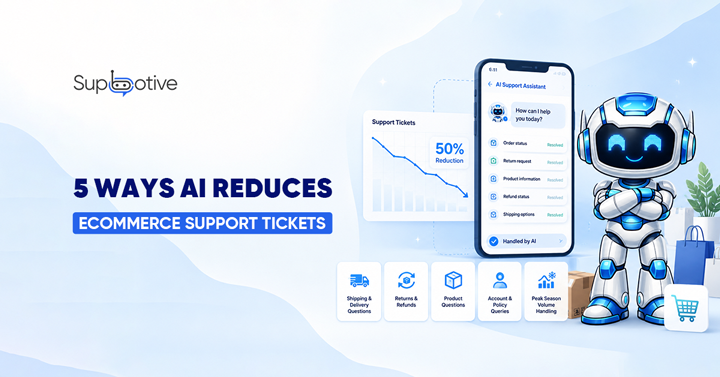
1. Instant Answers to Shipping and Delivery Questions
Shipping questions are the single biggest driver of ecommerce support volume. Brands that implement proactive tracking notifications across channels see WISMO ticket reductions of 60%. An AI chatbot handles shipping policy questions immediately how long delivery takes, what courier you use, whether free shipping applies, which countries you ship to. These are all answered from your shipping documentation in seconds. Note: Supbotive does not connect to live order tracking. Policy-based shipping questions are fully automated. Live shipment status queries escalate cleanly to your team with full context.2. Self Service Returns and Refund Guidance
Returns generate a huge share of repeat tickets and most of them follow the same pattern. What is the policy? How do I start returning? When do I get my money back? Businesses with comprehensive self-service options reduce ticket volume by 20 30% while maintaining or improving customer satisfaction scores. A well trained chatbot walks customers through your return process step by step, checks eligibility based on your policy, and only escalates when the case genuinely needs human judgment damaged items, disputes, unusual situations.3. Product Questions Answered Before Customers Abandon
Every unanswered product question is a potential lost sale and a potential support ticket. A customer wondering if a product comes in XL, or what it is made from, or how it compares to another option if they cannot get an answer fast, they leave. Then they come back after buying the wrong thing and open a return ticket. Answering product questions at the moment of decision prevents both the abandoned sale and the downstream support ticket.4. Automated Account and Policy Queries
Password resets. Discount code issues. How to update an email address. These questions have zero complexity they just need the right information delivered quickly. Instead of using a bot to collect information and hand it off to a human, the real unlock is when AI can actually resolve the issue end to end not just suggest what to say. For policy-based account queries, your chatbot resolves them completely. For queries that need a system action like cancelling an order it explains the process and escalates with full context so your agent can act immediately.5. Handling Peak Season Volume Without Hiring
Black Friday and Cyber Monday bring a 3 4x spike in ticket volume, which means support teams go from busy to drowning overnight. An AI chatbot does not have a capacity ceiling. It handles the same volume at 2am on Boxing Day as it does on a quiet Tuesday morning. The queries that flood in during peak season shipping deadlines, returns windows, and stock availability are exactly the policy-based questions a chatbot handles best. For UK ecommerce stores specifically, setting up WhatsApp automation before peak season is significantly easier than doing it during one.The Math Behind 50% Ticket Reduction
Here is a simple calculation to run on your own numbers. Take your monthly support ticket volume. Multiply by 0.6 that is the conservative estimate of automatable tickets. Multiply that number by your average cost per ticket ($2.70 $5.60 for ecommerce). That is your monthly saving from AI ticket deflection alone before factoring in faster resolution times, higher agent productivity, and improved customer satisfaction. McKinsey estimates that generative AI could reduce human serviced contacts by up to 50%, depending on a company’s existing level of automation. For most ecommerce stores starting from a manual baseline, 50% is achievable within the first few months.How Supbotive Handles This for Ecommerce Stores
For ecommerce businesses managing customer conversations on WhatsApp and Telegram, Supbotive is built for exactly this use case.
You add your shipping policies, return policies, product documentation, and FAQs. Supbotive trains on that content and starts handling routine queries immediately accurately, consistently, around the clock.
Every unanswered question gets flagged automatically. Your team adds the answer once. The chatbot handles it next time. The longer you use it, the less your team has to step in.
Want to see how Supbotive handles your real ecommerce queries? Book a live demo and bring your highest volume support questions.