

Most articles about the benefits of AI in customer service say the same things: “24/7 availability,” “cost savings,” “faster replies,” and “better customer experience.” Those are not wrong, but they are incomplete.
The real question is what those benefits actually mean for a business handling customer messages every day on WhatsApp, Telegram, or website chat. For a UK SME, AI customer service is not about replacing people. It is about reducing repetitive work, keeping answers consistent, and making sure human agents spend their time where they are genuinely needed.
1. Your Customers Get Answers at 2am Without You Being Awake
24/7 availability means customers can get answers outside normal working hours without waiting for the next business day.
A customer messaging at 11pm about a return policy does not need a human agent to be online. If the answer exists in your documentation, an AI chatbot can respond instantly in the same WhatsApp or Telegram conversation.
For UK businesses, this matters during weekends, Bank Holidays, Black Friday, Boxing Day, and January returns season. Customers do not stop asking questions because your team has logged off.
Zendesk’s CX Trends 2026 report says 74% of consumers now expect customer service to be available 24/7. AI makes that expectation easier to meet without adding night shifts.
2. Every Customer Gets the Same Correct Answer Every Time
Human agents can give slightly different answers depending on workload, training, mood, or shift timing. One agent may explain a refund policy clearly. Another may miss a condition or use outdated wording.
AI customer service reduces that inconsistency by retrieving answers from a knowledge base. With Supbotive, the chatbot is trained on your FAQs, policies, product guides, and internal support documentation.
That means the customer asking at 9am on Monday receives the same approved answer as someone asking at 11pm on Sunday. This is especially useful for returns, refunds, pricing, opening hours, booking steps, eligibility rules, and service processes.
3. Your Support Cost Per Conversation Drops
AI does not remove the need for human support, but it can reduce the number of routine conversations that reach your team. The cost difference becomes clear when a business is handling hundreds of repetitive messages every month.
If a human agent spends time answering the same return policy, delivery, payment, or account questions again and again, each answer carries a labour cost. AI reduces the cost of those repetitive conversations by answering them automatically from your approved documentation.
Human agents are then reserved for complex issues, complaints, disputes, and cases that need judgement. The value is not only lower cost. It is better to use the support team you already have.
4. Routine Queries Stop Reaching Your Team
Many ecommerce support queues are filled with the same types of questions:
- Shipping timelines
- Returns and refunds
- Payment questions
- Product information
- Account or order process questions
Most of these do not need human judgement. They need a clear, accurate answer.
AI customer support automation removes these repetitive queries from the queue before they become tickets. The customer gets the answer immediately, and the agent never has to handle the message.
This is one of the most measurable benefits of AI in customer service because it directly reduces support volume.
5. Your Team Focuses on Work That Actually Needs Them
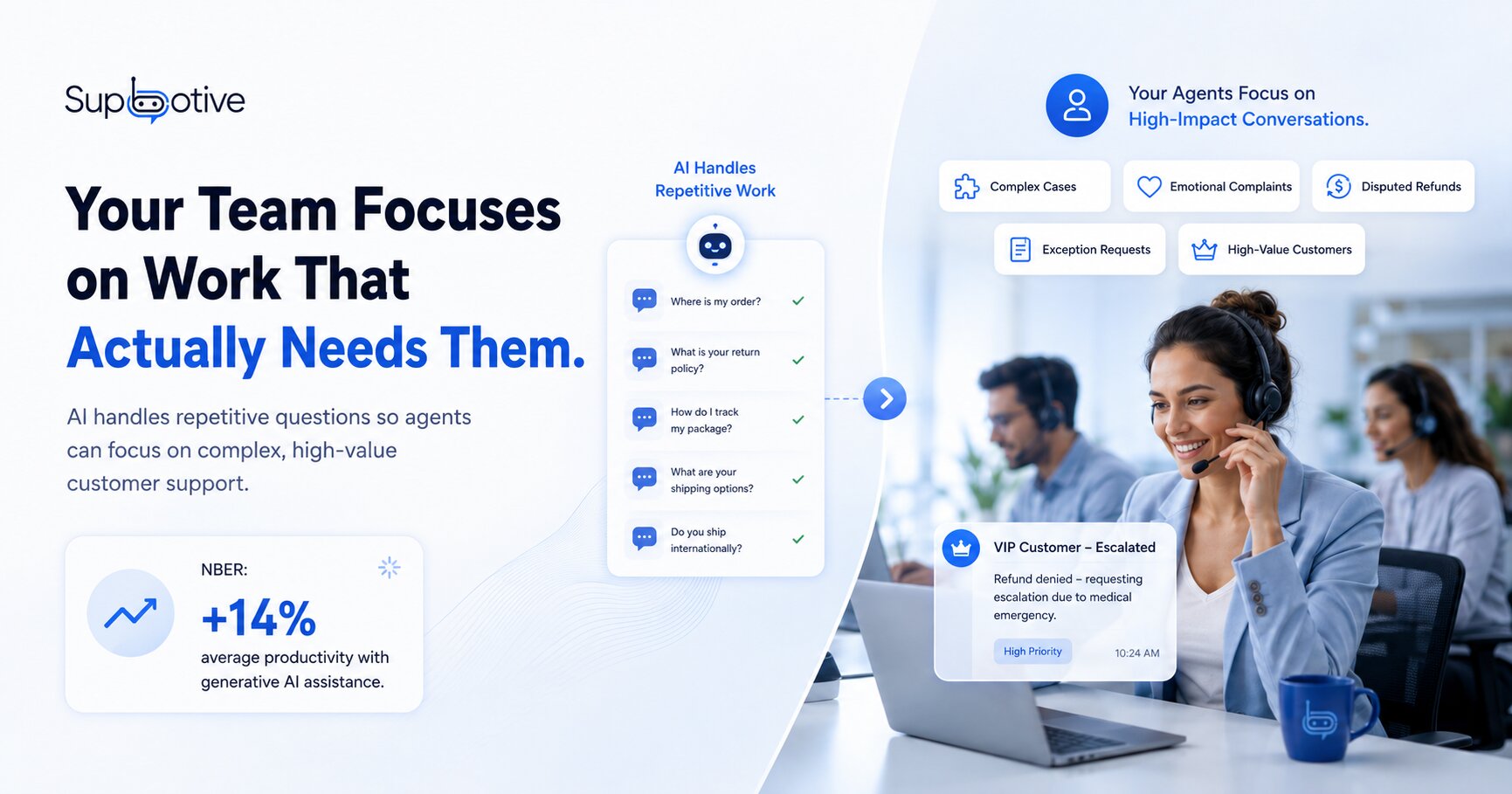
Good automation does not make support agents less important. It makes their time more valuable.
Instead of answering the same five questions all day, agents can focus on complex cases, emotional complaints, exception requests, disputed refunds, high-value customers, and conversations that require empathy.
Research from NBER found that customer support agents using generative AI assistance became about 14% more productive on average, with larger gains for newer or less-experienced agents.
For SMEs, that means AI can help smaller teams operate with more structure and confidence without forcing every customer through a human queue.
6. Your Support Scales Without Your Costs Scaling With It
Support volume does not grow evenly. It spikes. A product launch, delivery delay, campaign, influencer mention, seasonal sale, or Bank Holiday rush can multiply the number of customer messages overnight.
Human teams have a limit. AI chatbots can handle large volumes of routine questions at the same time. Whether 50 customers ask about a return policy or 500 do, the chatbot can answer from the same knowledge base without slowing down.
This makes AI particularly useful for UK ecommerce brands that face seasonal peaks around Black Friday, Christmas, Boxing Day, and January returns.
7. You See What Customers Are Struggling With
Every customer conversation contains insight. AI customer service can reveal which questions appear most often, which topics escalate most frequently, and where customers become confused. This helps businesses improve FAQs, policies, product pages, checkout flows, onboarding instructions, and internal processes.
Supbotive flags unanswered or unresolved queries, so your team can see where the knowledge base is missing information. Instead of guessing what customers need, you can improve support based on actual conversations. That turns customer support from a reactive inbox into a source of operational intelligence.
8. Frustrated Customers Reach a Human Faster
One of the most overlooked benefits of AI in customer service is smart escalation. A chatbot should not keep replying when a customer is clearly frustrated. Sentiment analysis can detect signs such as negative language, urgency, repeated contact, or messages written in capital letters.
When that happens, the chatbot should escalate the conversation to a human agent, even if the query is technically answerable. This prevents the worst version of automation: an angry customer receiving a calm, generic bot reply that makes them even more frustrated.
9. WhatsApp and Telegram Support Become More Professional
Many small businesses already use WhatsApp and Telegram for customer communication, but the process is often manual, unstructured, and difficult to manage at scale. Messages are missing. Agents repeat answers. Customers wait. There is limited visibility into unresolved conversations.
Supbotive turns WhatsApp and Telegram into structured support channels. Customers receive instant answers from your knowledge base, complex issues escalate to agents, and unresolved conversations stay visible. That means customers can contact you on the channels they already use without your team losing control.
10. Problems Get Resolved Faster Without More Staff
Faster support does not simply mean replying quickly. It means resolving the customer’s question sooner. AI can deliver instant first responses and handle straightforward queries in seconds.
For customers asking about opening hours, returns, refund timelines, service steps, or documentation requirements, that can be enough to resolve the conversation immediately.
For more complex cases, AI can gather context and pass the conversation to a human agent with the chat history attached. The agent does not start from zero, and the customer does not repeat the same problem again. This improves resolution speed without requiring more agents.
11. Your Chatbot Gets More Accurate Every Week
The best AI customer service systems improve because the knowledge base improves. When the chatbot cannot answer a question confidently, the conversation should be escalated and reviewed. Once the team provides the correct answer, that answer can be added to the knowledge base.
The next time a similar question appears, the chatbot can resolve it automatically. This is the compounding benefit of AI in customer service. The system becomes more useful over time because every unresolved query reveals what needs to be documented next.
What These Benefits Look Like Together
Not every AI customer service benefit matters equally to every business. A small healthcare provider may care most about safe escalation and consistent information. An ecommerce brand may care more about returns, refunds, WhatsApp volume, and peak-season scalability.
For UK businesses using WhatsApp and Telegram, the most immediate benefits are usually 24/7 answers, ticket deflection, faster resolution, support visibility, and scalable messaging support.
Together, these benefits create a support system that handles repetitive work automatically while keeping humans available for the conversations that actually need them.
How Supbotive Delivers These Benefits
Supbotive helps businesses automate repetitive customer support across WhatsApp and Telegram using their own documentation. It trains FAQs, policies, internal guides, and support knowledge, so answers stay consistent and controlled.
Routine queries receive instant replies, complex questions escalate to human agents with full conversation history, and unanswered queries are flagged, so the knowledge base improves over time. The result is automation-first customer support without losing human control.
FAQs
1. What are the main benefits of AI in customer service?
The main benefits include 24/7 availability, faster replies, lower support workload, consistent answers, better scalability, customer insights, and smarter human escalation.
2. How does AI customer service reduce costs?
AI reduces costs by handling repetitive questions automatically, which lowers the number of routine conversations human agents need to answer manually.
3. Which AI customer service benefits matter most for small businesses?
Small businesses usually benefit most from 24/7 replies, reduced repetitive workload, consistent answers, WhatsApp and Telegram automation, and human escalation for complex cases.
4. How quickly do businesses see the benefits of AI customer service?
Businesses can usually see early benefits once their knowledge base is properly set up and the chatbot starts answering recurring questions automatically. The impact improves as unanswered queries are reviewed and added back into the knowledge base.