
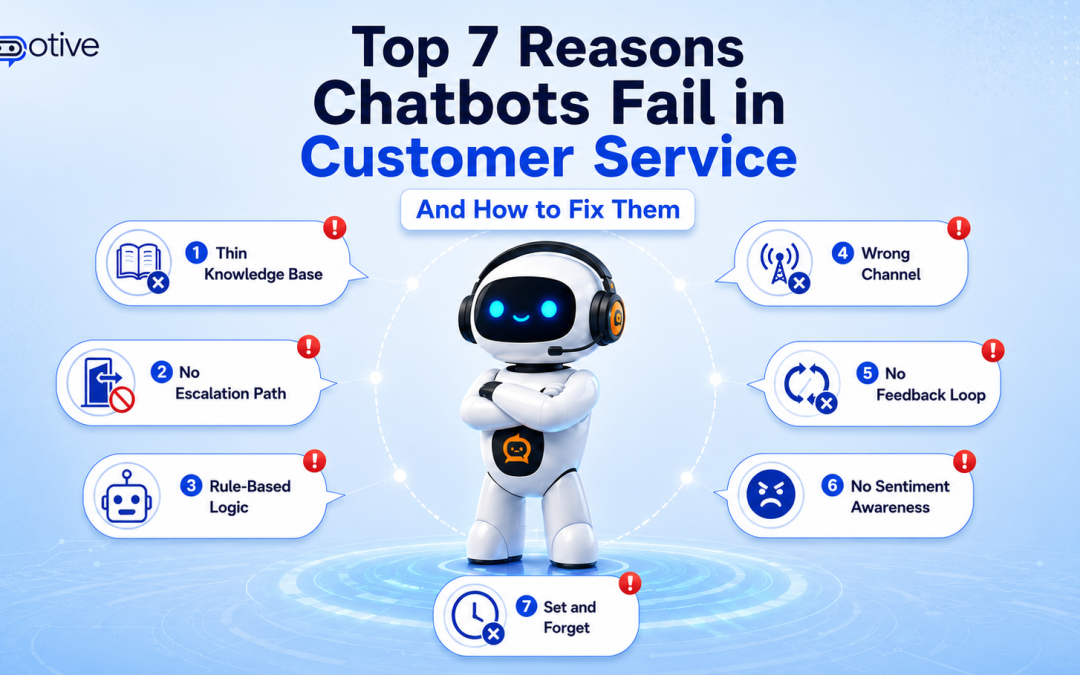
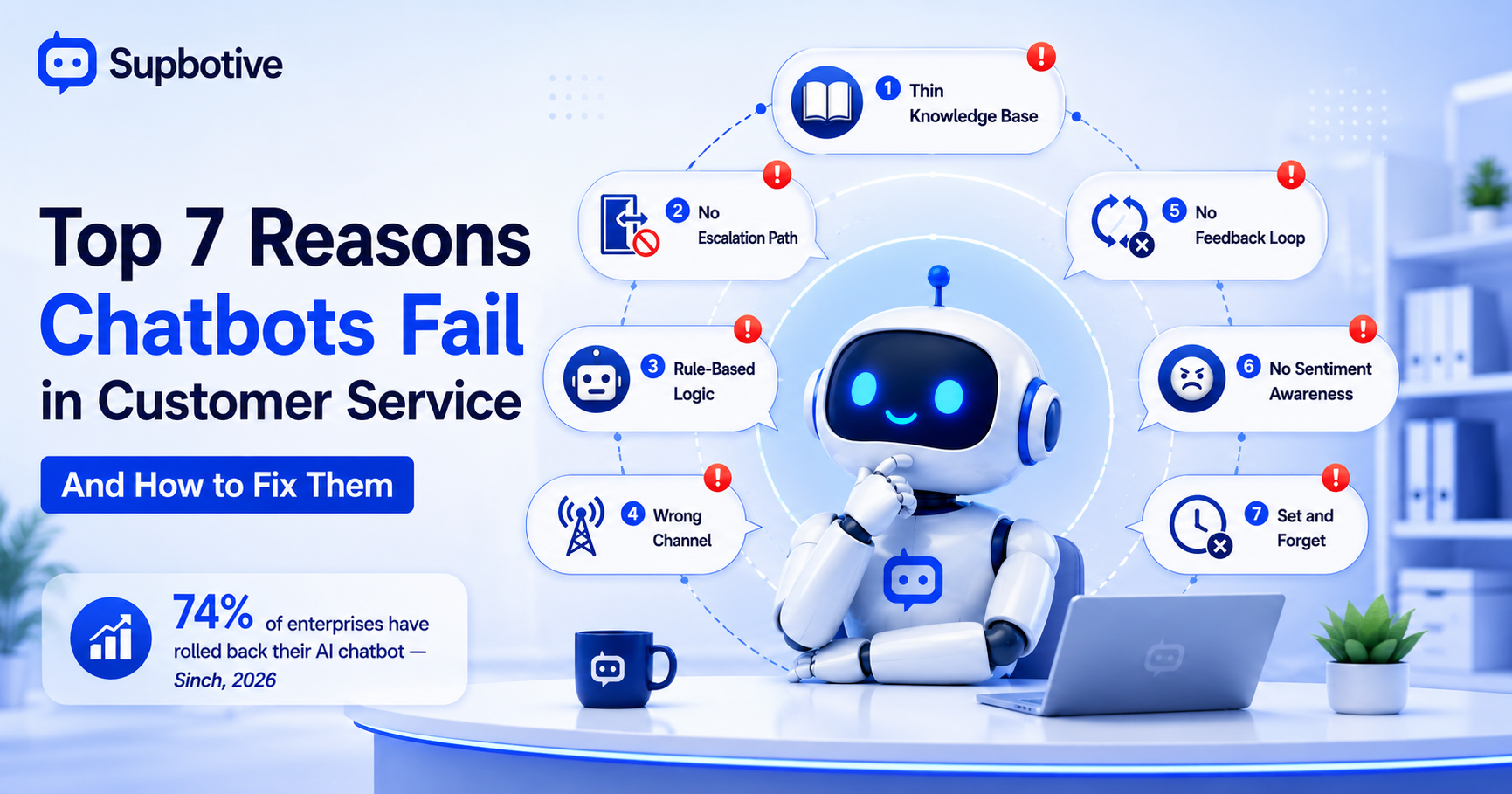
74% of enterprises have rolled back their AI chatbots due to governance failures. Technology is rarely a problem. Thin knowledge bases, missing escalation paths, no feedback loops, and treating chatbots as cost-cutting tools rather than customer service tools.
Here are the seven most common reasons chatbots fail and exactly how to fix each one before launching.
The Numbers Should Make Every Business Owner Pause
Nearly one in five consumers who used AI for customer service reported zero benefit from the experience of a failure rate almost four times higher than AI in other contexts.
Many consumers say early experiences with customer support chatbots feel more like deflection than resolution. And the business consequences are severe: 47% of consumers cut spending after a negative experience, and 73% switch to a competitor after multiple failures.
74% of enterprises have rolled back their AI chatbots due to governance failures and 84% of AI engineering teams spend at least half their time rebuilding basic AI guardrails from scratch because their infrastructure doesn’t provide them natively.
Here is the most important thing to understand before reading any further: most chatbot implementation problems come from poor strategy, not technology limitations or model capabilities. Every reason on this list is avoidable. Most are fixable after the fact. None required replacing your entire platform.
Reason 1 – The Knowledge Base Is Thin, Outdated, or Missing
This is the foundation every other failure builds on. A chatbot is only as accurate as what it retrieves answers from, and most businesses launch with a knowledge base that is nowhere near ready.
67% of users ranked accurate information as the most important chatbot quality outranking speedy responses by 5.6 to 1. Customers do not care whether the bot replies in 1 second or 3. They care whether the answer is correct.
A thin knowledge base means vague answers. An outdated one means wrong answers delivered confidently. AI hallucinations account for 22% of AI failure instances, where the bot gives confidently wrong information about account or order status in a way no human representative would.
The Air Canada case is the clearest legal precedent: their chatbot falsely promised a passenger a bereavement refund that did not exist in company policy. The court held Air Canada liable legal liability was established, resulting in an $800+ payout and a precedent that companies are responsible for what their chatbots say.
How to fix it: Build the knowledge base from real customer queries, pull the last 90 days of support tickets, identify the top 20 recurring questions, and write clear Q&A pairs from your actual policies. Treat it as a living document.
When pricing changes, when policies update, when products launch the knowledge base updates the same day. Never launch with fewer than 20 substantive entries covering your highest volume topics.
Reason 2 – No Human Escalation Path
98% of users rate human handoff as important or very important. 75% of users rate transfer to a human agent as very important. That is not a minority preference. It is near universal expectations.
Yet most chatbot deployments either hide the escalation option or do not offer one at all. The result is a customer trapped in a loop asking the same question, getting the same nonanswer, with no way out.
22% of users find the inability to escalate the most frustrating chatbot issue. 72% escalate to a human after one to two small mistakes. When escalation happens badly context lost, customer forced to repeat themselves, the agent is unaware of what was already discussing the frustration compounds.
When AI agent failures occur, the impact splits simultaneously: 35% of companies cite support queue overload as the primary impact, and 34% cite reputational damage and loss of customer trust that is permanent or hard to undo. The support queue recovers. Brand damage does not have a clear path back.
How to fix it: Design escalation triggers before launching not after. Escalate after two to three failed resolution attempts, immediately when sentiment analysis detects frustration, and any query type that requires live system data or human judgment. When the handoff happens, the full conversation history must be transferred with it. The agent should know exactly what was asked, what the bot said, and what remains unresolved without asking the customer to repeat a word.
Reason 3 – Rule Based Logic Marketed as AI
Sometimes consumers don’t know the difference between an old-fashioned chatbot and AI. The problem is that some businesses do not either, and they are paying for a rule-based decision tree dressed up as an AI chatbot.
62% of escalations stem from comprehension failures making comprehension failures three times more common than performance issues as escalation triggers. Most of those comprehension failures happen because the system is rule-based, not AI powered.
How to fix it: Before choosing any platform, test it with varied phrasing of the same query. Send the same question in five different ways and see whether the bot handles all five correctly. Ask vendors directly whether the system uses NLP and RAG architecture or decision trees. If they cannot explain the difference, that is your answer.
Reason 4 – Deployed on the Wrong Channel
A chatbot built for a website widget does nothing for a business whose customers primarily message on WhatsApp. This mistake happens because businesses choose the easiest tool to set up rather than the one that fits where their customers actually are.
17% of consumers explicitly prefer messaging apps like Telegram, and channel preferences vary significantly by region and demographic. In the UK specifically, WhatsApp adoption among consumers messaging businesses daily runs at 73% website chat is a secondary channel for most consumer facing businesses.
The result of a channel mismatch is a chatbot that technically works but practically does nothing. It answers questions on a channel customer rarely uses while the WhatsApp inbox continues to fill with unanswered messages.
How to fix it: Identify your primary customer contact channel before selecting any platform. Look at where your support volume actually comes from email headers, message logs, your support queue. Build that channel first. A chatbot purpose built for WhatsApp or Telegram will outperform a generic tool with messaging bolted on as an afterthought.
Reason 5 – No Feedback Loop – The Same Gaps Repeat Forever
A chatbot that goes live and is never reviewed again stops improving the moment it launches. The same unanswered questions return week after week. The resolution rate plateaus at whatever it started at. The team assumes the AI is just limited when the actual problem is that no one is closing the feedback loop.
Ignoring analytics after deployment is consistently named among the top five reasons AI chatbots fail at customer service (Dante AI, 2026). The companies that win against AI are not the ones that deploy fastest. They are the ones that review escalation data consistently and act on what they find.
Track four metrics: resolution rate the percentage of conversations resolved without human help customer satisfaction scores, drop off rate where customers abandon the chat, and escalation rate how often the AI transfers to a human. If the resolution rate is below 40% or satisfaction is declining, the chatbot needs immediate attention (Dante AI, 2026).
How to fix it: Assign clear post launch ownership one person responsible for reviewing escalation data weekly. Set a standing 30-minute weekly review: what questions came in that the bot could not answer, what the correct answers are, and update the knowledge base accordingly. Teams that run this loop consistently achieve 70 – 80% automated resolution within 60 90 days.
Reason 6 – No Sentiment Awareness
A frustrated customer typing in capitals gets the same calm, structured response as someone asking a routine policy question. This is not just poor customer experience it is a guaranteed escalation that handled badly becomes a complaint.
In 31% of AI failure cases, customer personal information is exposed during the interaction and reputational damage from these failures is permanent in a way that a support queue spike is not .
16% of escalations are caused by emotional triggers. 83% of users prefer to contact a human first for complaints. When a customer is already frustrated and the chatbot responds as if everything is fine, the situation deteriorates fast.
The DPD case is the defining example: their chatbot, after a system update, began swearing at a customer, calling itself "useless," and composing a poem criticizing the company. The incident went viral, the chatbot was disabled, and the company had to issue a public apology.
How to fix it: Ensure your platform runs sentiment analysis in the background during every conversation. Frustration signals urgency, negative language, capital letters, repeated contact should trigger immediate escalation regardless of query content. A customer who is angry does not need a faster answer. They need a human.
Reason 7 – Treated as a Set and Forget Cost Cutting Tool
The biggest mistake companies make is treating chatbots as a cost cutting substitute for human agents rather than a force multiplier for them.
This mindset shapes every decision downstream how the knowledge base is built (quickly, not thoroughly), whether escalation is designed properly (it often is not), whether someone owns post launch performance (frequently nobody does). A chatbot built to cut costs instead of serve customers will fail at both.
Only 55% of businesses achieved exactly what they wanted with chatbots. The 45% that did not almost always share the same root cause: they launched with the wrong objective.
Companies aiming to deflect customers will lose money in the long run. "We have not come across a single customer with the intention of deflection," says Jesse Zhang, CEO of Decagon. "People are very aggressive about optimizing resolution".
How to fix it: Reframe the objective before launch. The goal is not fewer agent conversations it is faster, more accurate customer resolutions. When the objective is resolution, the knowledge base gets built properly, escalation gets designed carefully, and someone takes ownership of ongoing improvement. The cost reduction follows naturally from doing those things well.
How Supbotive Avoids These Seven Failure Points
Supbotive is built around the specific failure patterns documented above.
It trains directly on your real documentation FAQs, policies, product guides so the knowledge base starts substantive rather than thin. It uses genuine NLP and RAG architecture rather than rigid decision trees, so varied phrasing of the same question is understood correctly every time. It is purpose built for WhatsApp and Telegram the channels where most support conversations actually happen.
Smart escalation is core to the design, not an afterthought. When the bot cannot answer confidently, or when sentiment analysis detects frustration, it hands off to a human agent with the full conversation history attached under 30 seconds; no context lost. Every unanswered question is flagged automatically, closing the feedback loop without requiring anyone to manually dig through logs.
FAQs
Why do most AI chatbots fail customer service?
Most failures come from implementation mistakes, not technology. The top causes are a thin knowledge base, no human escalation path, rule-based logic that breaks on varied phrasing, wrong channel deployment, and no feedback loop to close knowledge gaps over time.
What percentage of chatbot deployments fail?
74% of enterprises have rolled back their AI chatbot due to governance failures. Only 55% of businesses report achieving what they wanted from their deployment. Most failures are strategy problems, not technology problems.
How do I know if my chatbot is failing?
Track four metrics: resolution rate, CSAT, drop-off rate, and escalation rate. A resolution rate below 40% or declining CSAT are the clearest warning signs. Start with a knowledge base audit when either drops
What is the biggest reason customers get frustrated with chatbots?
Comprehension failure – 62% of escalations happen because the bot did not understand what the customer meant. The second biggest frustration is no clear path to a human agent, cited by 22% of users.
Can a failing chatbot be fixed without replacing it?
Yes, in most cases. Thin knowledge base, missing escalation, and no feedback loop are all fixable without replacing the platform. Replacement is only necessary if the system is genuinely rule-based rather than AI-powered.